

Over the summer of 2022, photographer and author Christina Riley was offered a ‘snorkelling’ residency on the west coast of Scotland as part of the global network of Mission Blue Hope Spots. Hope Spots are the brainchild of American oceanographer Dr Sylvia Earle, and were set up to help protect and restore marine biodiversity on a local, regional, national and international scale. Argyll’s project is one of a growing number around the globe.
Looking Down at the Stars confirms Riley’s need to look deeper, to look beneath the surface at the multitude of species most of us will never have the opportunity to encounter in the natural environment. Residents are guided by experts in snorkelling and in the marine habitat, with the resulting experiences filtered through artistic practice and shared with locals, visitors and local businesses, including businesses involved in sustainable fishing. Fishing sustainably, such as hand diving for scallops – a cultural practice in Argyll’s waters – exists in marked contrast to the horrors of industrial fishing. Over the past fifty years over-rapacious fishing has led to the virtual collapse of marine ecosystems across the world, including in British waters. In 2017, a number of Scottish initiatives came together under the banner Coastal Communities Network Scotland, including the Community Association of Lochs and Sounds (CAOLAS) and in Argyll, the Craignish Restoration of Marine and Coastal Habitats, or CROMACH. At Craignish the remit is both practical and motivational, literally getting under the water to replant seagrass meadows (who knew – underwater meadows!) and reseeding the sea bed with oyster sprat – just a couple of ways local communities have fostered dynamic change. Inviting resident artists to experience and communicate the wealth of underwater life found here is a way of disseminating those changes, as well as sharing the notion that so much more can be done across Scotland’s marine habitats.
Riley, however, knew nothing of this when she became aware of the Hope Spots opportunity. She did though, have an instant sense that this was something she absolutely needed to be involved in. Through Covid lockdowns she had previously documented her daily walks on the beach close to her home on the Clyde estuary, resulting in the book The Beach Today, and where the strandline sparkled with chocolate wrappers and crisp packets, or an empty can of Tennent’s had been crushed ‘into the foetal position.’ Craignish is around a hundred miles north of the Clyde by road – thanks to Scotland’s heavily indented west coast. As the summer residency progresses Riley gets on with the business of immersing herself daily in the inland waters, hungry for new knowledge, and transforming the whole into a work where philosophical enquiry is deeply attached to the observed world. The result is much more than merely lyric ‘nature’ writing.
‘Anything I write about the sea can only come from the perspective of land, and never will I be able to write truthfully about the way an octopus understands coralline algae enough to camouflage itself against its purple encrustations, despite being unable to see colour itself.’ The successful negotiation of the self in relation to the observed world demands an ability to transform observations and experiences into empathetic thought, but also to keep a whether eye out for motivation and prejudice. ‘How could I ever write about an octopus other than to tell you how it makes me feel to live on Earth at the same time as that octopus? To tell you that the octopus, that all of it, is miraculous;’ of the importance of loving that which we don’t understand.
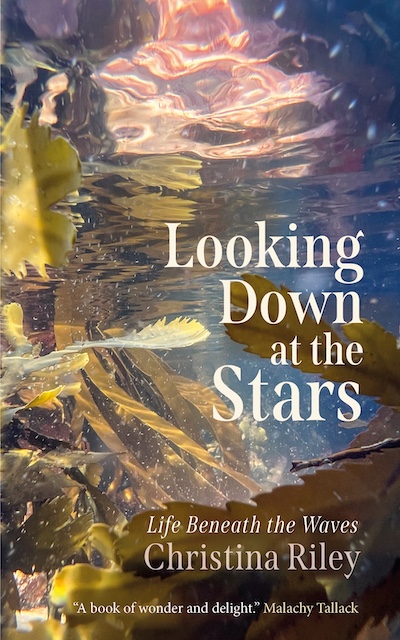
In a series of fragments, Riley negotiates the life we mostly do not see, mussels, seagrass, serpulid (a species of worm) sea squirt, anemone, barnacle, sea lemon and more. Here too is a renegotiation of colour itself; that underwater the colour red ‘is the first to disappear, vanishing at around fifteen feet..’ that ‘A beautiful thing happens when a mussel grows too close to stone,’ that ‘A scallop can have two hundred eyes, each one made of tiny mirrors, each mirror a mosaic of living crystals.’
The closing essay takes the form of an interview with celebrated wildlife cameraman and native of Argyll John Aitchison, the conversation usefully panning back and forth between the wider world (humpback whales in Mexico) and Argyll, negotiating the complex nature of nature itself, particularly in an era where the human potential for recovery is a defiant and radical act of hope in the face of our capacity to inflict ongoing damage. There is a simple truth here, that thinking globally but acting locally is a vital approach to activism. We cannot fix the world, but there’s a world to build on our own doorsteps. Argyll’s Hope Spots and Riley’s attentive response both do this in spades.

Karen Lloyd
Karen Lloyd is a senior researcher with Lancaster University’s Future Places Centre. Her work has been widely published, including Abundance; Nature in Recovery, (Bloomsbury, 2021) and The Gathering Tide (Saraband, 2015) She is editor of North Country: Anthology of Landscape and Nature. She lives in the English Lake District.